Imagine having a vibrant, razor-sharp 100-inch screen that fits in the palm of your hand. This isn’t science fiction; it’s the reality offered by the Mini Laser Projector. These compact powerhouses are changing the game for home entertainment, business presentations, and on-the-go media consumption. Forget bulky, noisy projectors of the past. Laser technology has ushered in a new era of portability without compromising on quality.
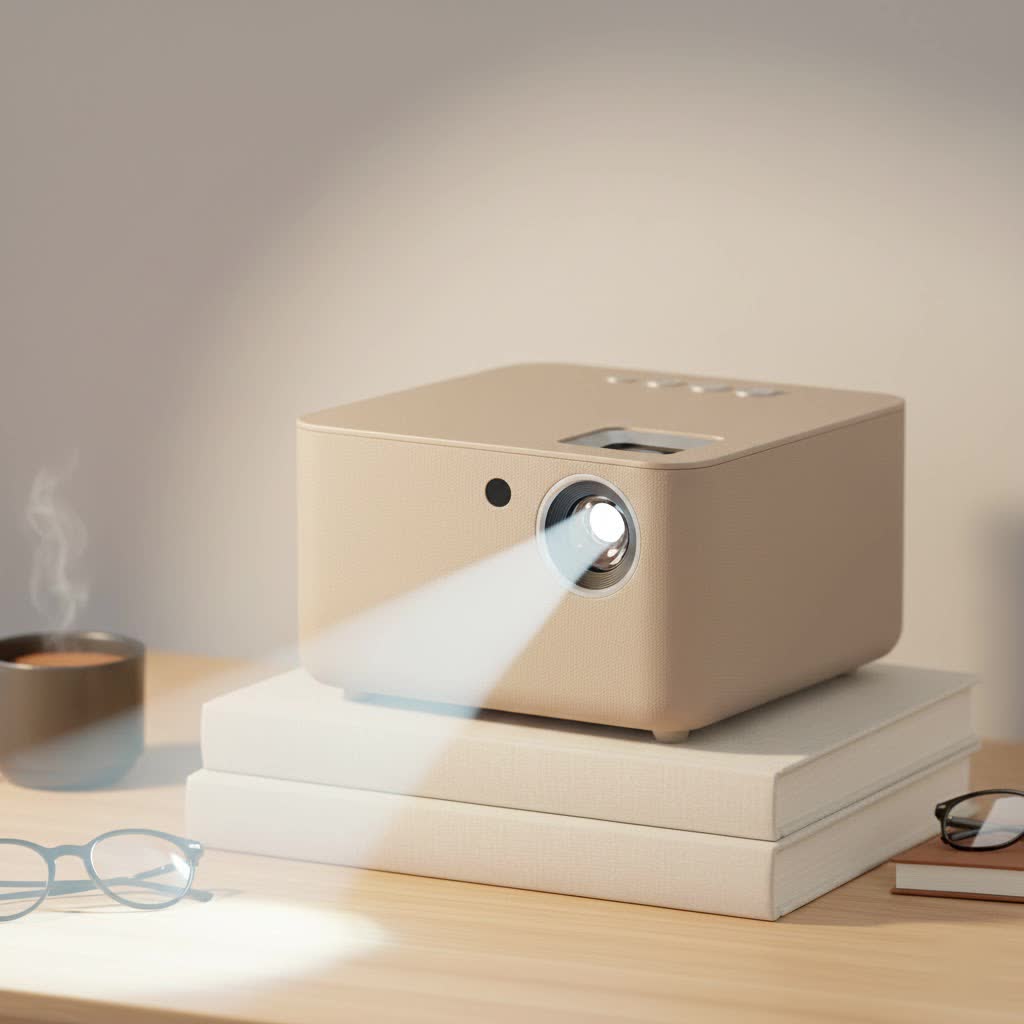
As the lead content creator at Flasf.com, I’ve spent over a decade testing, comparing, and dissecting every type of portable projector on the market. In this comprehensive guide, we’ll dive deep into what makes a mini laser projector tick, why it might be the perfect choice for you, and what to look for when you’re ready to buy.
How Exactly Does a Mini Laser Projector Work?
To appreciate the magic, you need to understand the technology. Unlike traditional projectors that use a single lamp (like an incandescent bulb) and filter it through a color wheel or LCD panels, a mini laser projector uses a more sophisticated approach.
It employs precise, solid-state lasers—typically red, green, and blue—as its light source. These lasers are directed at a micro-mirror device (like a DLP chip) or liquid crystal panels (LCOS) that shape the light into the image you see on the screen. This method offers incredible control over light and color, resulting in a superior viewing experience.
“The core advantage of a laser light source is its purity and stability,” explains Dr. Evelyn Reed, an optical engineer with over 15 years in projection technology. “Lasers produce pure, concentrated light, which allows for a much wider color gamut and deeper black levels than a standard UHP lamp. The image is simply more vivid and true-to-life.”
The Key Advantages of Going Laser
So, why choose a mini laser projector over other portable options? The benefits are significant and impact everything from image quality to long-term cost.
- Spectacular Image Quality: Lasers produce incredibly rich and saturated colors. The ability to achieve a wider color gamut means you’ll see shades and tones that lamp-based projectors simply can’t reproduce. The contrast ratio is also typically higher, leading to inky blacks and bright whites in the same frame.
- Incredible Durability and Lifespan: A traditional projector lamp has a lifespan of around 2,000 to 5,000 hours and requires expensive replacement. A laser light source, on the other hand, can last for 20,000 to 30,000 hours. That’s equivalent to watching a two-hour movie every single day for over 27 years.
- Instant On/Off Functionality: Lamp-based projectors need time to warm up to reach full brightness and require a cool-down period before you can pack them away. A mini laser projector turns on and off almost instantly, just like a TV.
- Lower Maintenance and Energy Efficiency: With no lamps to replace, maintenance is virtually zero. Lasers are also more energy-efficient, which is a crucial advantage for battery-powered portable devices.
- Consistent Brightness: Projector lamps dim over their lifespan, meaning the image gets progressively worse. A laser light source maintains its brightness level much more consistently throughout its entire life.
Are There Any Downsides to Consider?
No technology is perfect, and it’s important to have a balanced view. While the advantages are compelling, there are a couple of potential drawbacks to keep in mind.
The most significant factor is often the upfront cost. The advanced technology in a mini laser projector generally makes it more expensive than a comparable mini projector using LED or DLP lamp technology. However, when you factor in the lack of replacement lamps and lower energy consumption, the total cost of ownership can be lower over time.
Another phenomenon unique to laser projectors is “laser speckle.” This can sometimes appear as a faint, shimmering, or grainy texture, especially on solid bright colors. While manufacturers have developed advanced optics to minimize this effect, it can still be noticeable to viewers with a very critical eye.
Mini Laser Projector vs. Traditional LED/DLP Minis
When you’re shopping for a portable projector, you’ll mainly see two types: laser and LED. Both are vast improvements over old lamp technology, but they have distinct differences.
| Feature | Mini Laser Projector | Mini LED Projector |
|---|---|---|
| Light Source | Solid-state lasers | Light Emitting Diodes (LEDs) |
| Color Gamut | Excellent (often exceeds Rec. 709) | Very Good (typically covers sRGB/Rec. 709) |
| Contrast | Superior, with deeper blacks | Good, but often not as deep as laser |
| Brightness | Can achieve higher brightness levels | Generally more limited in peak brightness |
| Lifespan | 20,000 – 30,000 hours | 20,000 – 30,000 hours |
| Cost | Higher upfront investment | More budget-friendly |
| Heat Output | Generally lower, requiring less cooling | Very low, ideal for compact designs |
An LED mini projector is a fantastic choice for budget-conscious buyers who still want a reliable and long-lasting device. However, if you are a cinephile who prioritizes the absolute best color accuracy and contrast, a mini laser projector is the undisputed champion.
Your Buying Guide: What to Look for
Ready to choose your own mini laser projector? Here are the critical features to evaluate to ensure you get the best device for your needs.
1. Resolution
|
Our Picks for the Best Mini Projector in 2026
As an Amazon Associate I earn from qualifying purchases.
|
||
| Num | Product | Action |
|---|---|---|
| 1 | Aurzen EAZZE D1 Smart Projector with WiFi and Bluetooth, Netflix-Officially-Licensed, Auto Focus & Keystone, DoIby Audio, Native 1080P Movie, Portable Outdoor Mini Projector, White |

|
| 2 | SOOMFON Mini Projector 1080P Support - Portable Small Video Movie Projector Bluetooth 5.1 Auto Keystone Electric Focus for Bedroom/Wall/Home/Outdoor/iPhone/Android/TV Stick |
|
| 3 | [Compatible with Netflix & TOF Real-time Focus] Mini Projector with WiFi and Bluetooth, XuanPad Smart Projector 4K Support, Dolby Audio & Keystone, 210° Rotatable Stand for Home |
|
| 4 | Magcubic Mini Projector with WiFi 6 and Bluetooth 5.4, Portable Projector 4K Support, 5W Soundbase Speaker, Auto Vertical Keystone 180°Rotatable Smart Proyector for Movie Home Outdoor |
|
| 5 | 【Officially-Licensed APP & Native 1080P】Thinnest 1.81\" Smart Mini Projector with WiFi and Bluetooth, Auto Focus & Keystone Portable Outdoor Projector, VOPLLS 4K Support Home Movie Projector |
|
| 6 | HAPPRUN Native 1080P Bluetooth Mini Projector, Full HD Portable Outdoor Movie Projector with Built-in Speaker, Compatible with Smartphone, HDMI, USB, AV, Fire Stick, PS5 for Home, Bedroom, Outdoor Use |
|
| 7 | [Built-in Apps & 2025 Upgraded] Mini Projector Support 4K 1080P Auto Keystone 270° Rotatable with WiFi 6 and Bluetooth 5.4, Projector Portable Compatibile with HDMI/TV Stick/Memory Stick/Laptop-Black |
|
| 8 | Aurzen Roku TV Smart Projector with Wifi and Bluetooth, Roku Streaming Experience Built-in, 1080P FHD, Dolby Audio, Auto Focus & Keystone, Zoom, Movie Portable Outdoor Mini Projector, White |
|
| 9 | Mini Portable Projector 4K WiFi 6 BT 5.2 Upgraded Portable Projector Full HD Supported for Phone /PC /TV /HDMI /PS5 /Laptop Auto Keystone Home Theater 180° Rotation [Built-in App] White |
|
| 10 | [Short Throw/1200ANSI/Built in Apps] 4K Outdoor Projector with WiFi and Bluetooth, Auto Focus Projector with Dual-Mode Stand, Smart Portable Proyector with Netflix/YouTube/PrimeVideo & Dolby |
|
This determines the sharpness and clarity of the image. For a mini projector, look for at least a Native 1080p (1920×1080) resolution. Some premium models offer 4K support, which means they can accept a 4K signal and downscale it to their native resolution, often resulting in a more detailed image. Avoid models that only list “supports 1080p” but have a low native resolution like 480p.
2. Brightness (ANSI Lumens)
Brightness is arguably the most important specification. It’s measured in ANSI lumens, which is a standardized measurement. Don’t be fooled by vague “lumens” or “lux” ratings. For a mini laser projector, a good starting point is 300-500 ANSI lumens for use in a dark room. If you plan to use it with some ambient light, you’ll want to look for 600 ANSI lumens or more.
3. Connectivity
How will you get your content to the projector?
- HDMI: The essential port for connecting laptops, game consoles, and streaming sticks.
- USB-C: A modern, versatile port that can often handle video, data, and even power delivery.
- Wireless: Look for built-in Wi-Fi and Bluetooth. Wi-Fi allows for screen mirroring from your phone or laptop, while Bluetooth lets you connect external speakers or headphones for better audio.
4. Battery Life
The essence of portability is being free from plugs. Check the projector’s battery capacity, usually rated in milliamp-hours (mAh) or a runtime estimate in hours. A good benchmark is a battery that can last for at least 2 to 2.5 hours, long enough to get through a full movie.
5. Smart Features
Many modern mini projectors run on an operating system like Android TV. This gives you direct access to streaming apps like Netflix, YouTube, and Disney+ without needing to connect an external device. This is a huge convenience for a portable setup.
Frequently Asked Questions (FAQ)
What is the ideal screen size for a mini laser projector?
Most mini laser projectors are optimized for screen sizes between 60 and 120 inches. While you can go larger, the image will become dimmer. For the best balance of size and brightness, an 80-100 inch screen is often the sweet spot.
Can I use a mini laser projector for gaming?
Absolutely! The fast response times and excellent color of a mini laser projector make it a great option for casual and even competitive gaming. Just be sure to check the projector’s input lag specification; for serious gaming, you’ll want something under 40ms.
Do I need a special screen for a laser projector?
While you can project onto any light-colored, smooth wall, an ALR (Ambient Light Rejecting) screen can dramatically improve contrast and color saturation, especially in rooms that aren’t completely dark.
Are laser projectors safe for your eyes?
Yes, they are safe for normal viewing. Projectors use diffused light, meaning the light bounces off a screen before reaching your eyes, which is much gentler than looking directly at a light source like a TV. However, you should never look directly into the lens of any projector.
How do I maintain a mini laser projector?
Maintenance is minimal. The sealed laser light source requires no attention. The only thing you’ll need to do is periodically clean the lens with a microfiber cloth and ensure the air vents are clear of dust to allow for proper cooling.
The Final Picture
The mini laser projector represents a significant leap forward in portable entertainment. It offers a combination of stunning image quality, longevity, and convenience that was previously unattainable in such a small form factor. While the initial investment may be higher than for an LED model, the superior performance and lack of maintenance make it a worthwhile choice for anyone serious about high-quality, on-the-go projection. Whether for impromptu movie nights, dynamic business pitches, or immersive gaming sessions, this technology puts a powerful cinematic experience right in your pocket.
