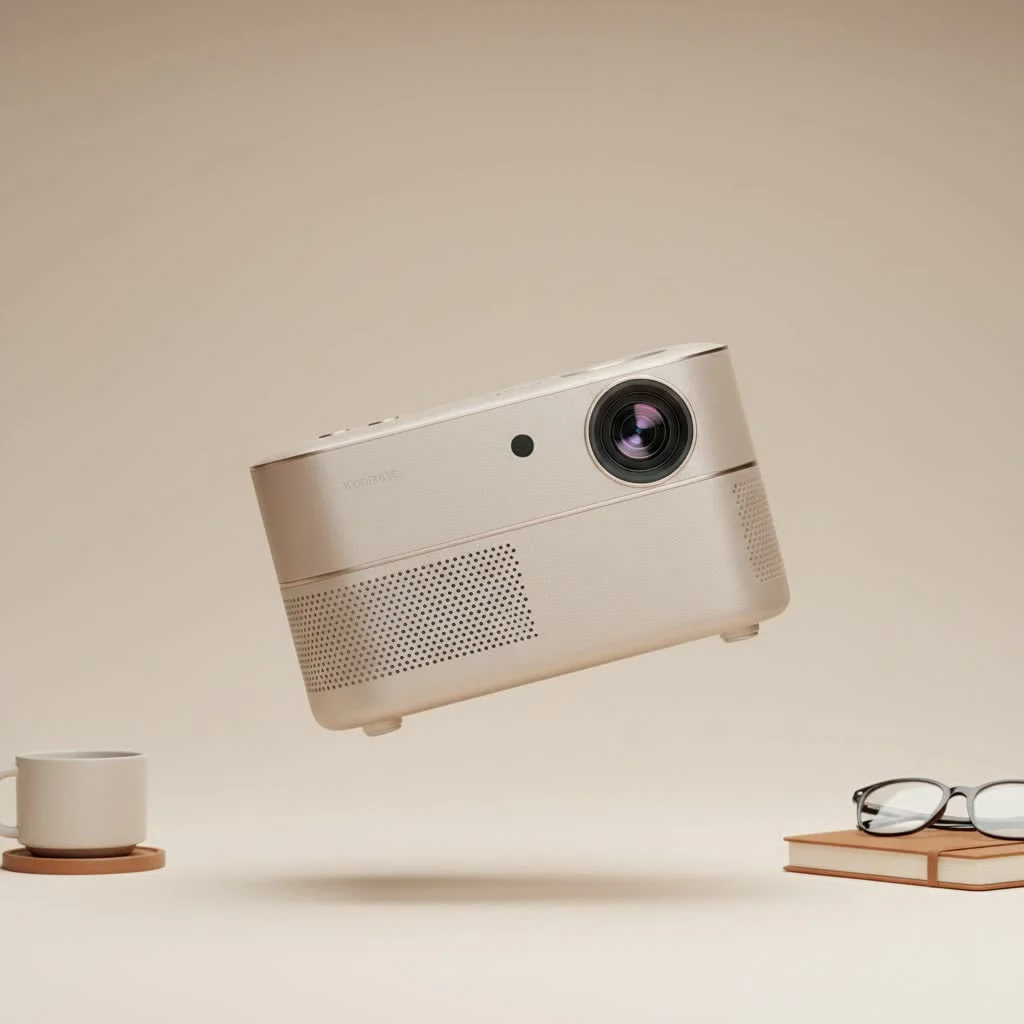
A mini hologram projector creates mesmerizing 3D visuals that appear to float in mid-air, captivating audiences without the need for special glasses. These devices typically use either spinning LED fans or holographic pyramids to achieve a powerful 3D illusion, making futuristic displays accessible for various applications from retail advertising to educational tools.
What Exactly is a Mini Hologram Projector?
Most devices marketed as a mini hologram projector do not create true holograms, which involve complex laser technology. Instead, they engineer a powerful 3D illusion. These devices generally fall into two main categories: spinning LED fans and holographic pyramids. Both types create the effect of an image floating freely in the air, providing a high-impact visual experience without requiring special glasses.
These projectors are designed for a variety of uses, from eye-catching advertisements in retail stores to dynamic educational tools in classrooms. Their compact size makes them incredibly versatile and portable.
How Do These Miniature Marvels Actually Work?
The magic behind these displays is rooted in clever visual principles. Understanding their operation helps users appreciate the technology and choose the right type for their specific needs.
The Spinning LED Fan Explained
The most common type of commercial mini hologram projector is the holographic fan. This device consists of blades embedded with a strip of RGB LEDs. When the fan spins at a high speed, often exceeding 750 RPM, the LEDs light up in a precisely programmed sequence.
This rapid movement leverages a principle called “Persistence of Vision” (POV). Your eyes and brain cannot process the individual spinning blades; instead, they blend the rapidly changing light points into a single, stable image. Because the hardware is practically invisible while spinning, the resulting image appears to be a 3D hologram floating in mid-air, creating an incredibly effective illusion.
The Smartphone Pyramid Projector
The second type, often used for smaller, personal applications, is the pyramid projector. This method uses a simple transparent, four-sided pyramid, which is placed upside down on a smartphone or tablet screen.
This technique is a modern take on a 19th-century illusion called “Pepper’s Ghost.” A special video, which displays four identical images oriented towards each side of the pyramid, is played on the screen. Each side of the pyramid reflects the image from the screen below it, and when viewed from the side, these four reflections converge in the center to form a single, 3D-like image that appears to be enclosed within the pyramid.
Top Applications for a Mini Hologram Projector
The potential uses for these devices are vast and exciting. Their ability to grab attention makes them a powerful tool for communication and entertainment.
- Retail and Advertising: A floating 3D logo, a rotating image of a product, or a special promotion can stop shoppers in their tracks. Holographic fans are perfect for storefronts, malls, and trade show booths.
- Education: Teachers can use a mini hologram projector to display complex 3D models, such as DNA strands, planetary systems, or historical artifacts, making abstract concepts tangible and more engaging for students.
- Events and Entertainment: Add a “wow” factor to parties, weddings, or corporate events with floating animations, messages, or decorative visuals.
- Presentations and Prototyping: Designers and engineers can use these projectors to visualize 3D models and product prototypes in a more dynamic way than a simple screen presentation.
Choosing the Right Mini Hologram Projector for You
With a growing market, selecting the right device can seem daunting. Focusing on a few key specifications will help you make an informed decision that aligns with your goals.
| Feature | What to Look For | Why It Matters |
|---|---|---|
| Resolution | Higher pixel count (e.g., 1024×1024) | Determines the sharpness and clarity of the image. Higher resolution is crucial for detailed logos or product models. |
| Brightness | Measured in nits (cd/m²). Look for 1600 nits or higher. | Higher brightness ensures the hologram is vibrant and visible, especially in well-lit environments. |
| Size (Diameter) | Ranges from 30cm to 100cm+ | The size of the fan determines the maximum size of your holographic display. Larger is better for public spaces. |
| Connectivity | Wi-Fi, SD Card, Cloud Control | Wi-Fi and cloud options offer the convenience of updating content remotely, which is ideal for managing multiple displays. |
| Software | User-friendly app or desktop software | The ease of uploading, converting, and managing your 3D content is critical for a smooth user experience. |
Key Factors to Consider Before Buying
|
Our Picks for the Best Mini Projector in 2026
As an Amazon Associate I earn from qualifying purchases.
|
||
| Num | Product | Action |
|---|---|---|
| 1 | [Short Throw/1200ANSI/Built in Apps] 4K Outdoor Projector with WiFi and Bluetooth, Auto Focus Projector with Dual-Mode Stand, Smart Portable Proyector with Netflix/YouTube/PrimeVideo & Dolby |
![Check [Short Throw/1200ANSI/Built in Apps] 4K Outdoor Projector with WiFi and Bluetooth, Auto Focus Projector with Dual-Mode Stand, Smart Portable Proyector with Netflix/YouTube/PrimeVideo & Dolby on Amazon](https://flasf.com/wp-content/plugins/amazon-tables/assets/images/buy.png)
|
| 2 | HAPPRUN Native 1080P Bluetooth Mini Projector, Full HD Portable Outdoor Movie Projector with Built-in Speaker, Compatible with Smartphone, HDMI, USB, AV, Fire Stick, PS5 for Home, Bedroom, Outdoor Use |
|
| 3 | SOOMFON Mini Projector 1080P Support - Portable Small Video Movie Projector Bluetooth 5.1 Auto Keystone Electric Focus for Bedroom/Wall/Home/Outdoor/iPhone/Android/TV Stick |
|
| 4 | Aurzen EAZZE D1 Smart Projector with WiFi and Bluetooth, Netflix-Officially-Licensed, Auto Focus & Keystone, DoIby Audio, Native 1080P Movie, Portable Outdoor Mini Projector, White |
|
| 5 | [Built-in Apps & 2025 Upgraded] Mini Projector Support 4K 1080P Auto Keystone 270° Rotatable with WiFi 6 and Bluetooth 5.4, Projector Portable Compatibile with HDMI/TV Stick/Memory Stick/Laptop-Black |
|
| 6 | Mini Portable Projector 4K WiFi 6 BT 5.2 Upgraded Portable Projector Full HD Supported for Phone /PC /TV /HDMI /PS5 /Laptop Auto Keystone Home Theater 180° Rotation [Built-in App] White |
|
| 7 | 【Officially-Licensed APP & Native 1080P】Thinnest 1.81\" Smart Mini Projector with WiFi and Bluetooth, Auto Focus & Keystone Portable Outdoor Projector, VOPLLS 4K Support Home Movie Projector |
|
| 8 | [Compatible with Netflix & TOF Real-time Focus] Mini Projector with WiFi and Bluetooth, XuanPad Smart Projector 4K Support, Dolby Audio & Keystone, 210° Rotatable Stand for Home |
|
| 9 | Magcubic Mini Projector with WiFi 6 and Bluetooth 5.4, Portable Projector 4K Support, 5W Soundbase Speaker, Auto Vertical Keystone 180°Rotatable Smart Proyector for Movie Home Outdoor |
|
| 10 | Aurzen Roku TV Smart Projector with Wifi and Bluetooth, Roku Streaming Experience Built-in, 1080P FHD, Dolby Audio, Auto Focus & Keystone, Zoom, Movie Portable Outdoor Mini Projector, White |
|
Beyond the specs, practical aspects are important. For fan-style projectors, safety is paramount. Since the blades spin at very high speeds, always opt for a model that includes a protective acrylic shell or case to prevent accidents, especially in public areas.
As Dr. Alistair Finch, a specialist in visual technologies, notes, “The effectiveness of a holographic display isn’t just in the hardware, but in the content. Ensure the device you choose has a straightforward content pipeline, allowing you to easily create and upload the high-quality 3D animations that will truly engage your audience.”
Can You Make Your Own DIY Hologram Projector?
If you’re curious about the technology and want a fun project, you can easily create your own smartphone pyramid projector at home. It’s a great way to understand the Pepper’s Ghost principle firsthand.
What You’ll Need:
- An old CD case
- A craft knife or box cutter
- Tape or superglue
- A ruler and a pen
- Your smartphone
Simple Steps:
- Carefully break off the edges of the CD case so you have a flat, square piece of clear plastic.
- Use the ruler and pen to draw a trapezoid shape on the plastic. A good size is 1cm at the top, 6cm at the bottom, and 3.5cm tall.
- You will need four identical trapezoid pieces. Carefully cut them out using the craft knife.
- Tape or glue the slanted sides of the four pieces together to form a pyramid or funnel shape.
- Find a “hologram video” on a platform like YouTube (search for “pyramid hologram video”). Place the pyramid upside down on the center of your phone screen while the video is playing.
- Dim the lights and enjoy your very own 3D hologram!
Frequently Asked Questions (FAQ)
Are these real holograms?
Technically, no. Most commercially available mini projectors create a 3D illusion using either the Persistence of Vision principle (LED fans) or the Pepper’s Ghost effect (pyramids). True holography involves splitting laser beams and is far more complex.
What kind of content can I display on a mini hologram projector?
These devices play specially formatted video files. For fan displays, this is often a 3D animation with a black background, which is converted by the device’s software. For pyramids, you need a video that shows four synchronized views of an object.
Is a mini hologram projector expensive?
The cost varies dramatically. A DIY pyramid projector costs next to nothing. Consumer-grade LED fans can range from a couple of hundred dollars to several thousand for large, high-resolution, and network-enabled professional models.
Are hologram fans dangerous?
Yes, the spinning blades can be dangerous if touched. It is absolutely essential to use a protective cover or enclosure if the device is installed anywhere within reach of people, especially children.
Do hologram projectors work in daylight?
They work best in dimly lit or dark environments, which enhances the “floating” effect. However, models with very high brightness (1600 nits or more) are designed to be visible and effective even in brightly lit indoor spaces or during the day.
Conclusion
The mini hologram projector is a transformative piece of technology that bridges the gap between digital content and the real world. While it may rely on clever illusion rather than pure holography, the effect is no less magical. Whether you are a business owner looking for an innovative advertising tool, an educator seeking to inspire students, or simply a tech enthusiast, these devices offer an exciting glimpse into the future of visual displays. By understanding the technology and choosing the right features, you can unlock a new dimension of communication and leave a lasting impression on your audience.
Frequently Asked Questions
Are mini hologram projectors true holograms?
No, most commercially available mini projectors create a 3D illusion rather than true holograms. They achieve this using principles like Persistence of Vision (for LED fans) or the Pepper's Ghost effect (for pyramids), which are distinct from complex laser-based holography.
What types of content can be displayed on these projectors?
These devices display specially formatted video files. For fan displays, this typically involves 3D animations with a black background, processed by the device's software. Pyramid projectors require videos showing four synchronized views of an object for the illusion to work.
What is the typical cost of a mini hologram projector?
The cost varies significantly based on type and features. A DIY pyramid projector can be made for almost no cost. Consumer-grade LED fans generally range from a few hundred dollars, while professional, high-resolution, and network-enabled models can cost several thousand dollars.
Are hologram fans safe to use in public spaces?
Hologram fans can be dangerous if the spinning blades are touched due to their high rotation speeds. It is crucial to use a protective cover or enclosure, especially when the device is installed in public areas or within reach of children, to prevent accidents.
Can mini hologram projectors be used in bright environments?
Mini hologram projectors generally perform best in dimly lit or dark environments, which enhances the floating effect. However, models with very high brightness, specifically those rated at 1600 nits or more, are designed to be visible and effective even in brightly lit indoor spaces or during daylight hours.
Get our weekly buyer guide
Practical specs, not advice. Unsubscribe anytime.
I picked up one of the spinning LED fan projectors mentioned here for my small boutique, and it’s been a game-changer for attracting attention. The 3D visuals really do look like they’re floating in mid-air, and customers are always stopping to watch. It was super easy to set up and has definitely boosted engagement with our window display. Highly recommend for any retail space!
I got a holographic pyramid style projector for a recent presentation, and it worked pretty well. The illusion of a 3D image without glasses is really cool and definitely made my presentation more memorable. My only minor complaint is that it needs a fairly dark room to really pop, but that’s to be expected with this kind of tech. Overall, I’m happy with the purchase.
This guide helped me understand the difference between true holograms and the 3D illusion these mini projectors create. I ended up getting a spinning LED fan model for my home office, and it’s fantastic for adding a futuristic touch. It’s surprisingly bright and the images are really captivating. My friends are always asking where I got it!
I was excited about the idea of a mini hologram projector for some educational tools, but the one I got didn’t quite live up to the hype. While the 3D effect is neat, the resolution on smaller text was a bit fuzzy, making it less ideal for detailed learning materials. It’s fun for simple visuals, but if you need crisp detail, you might want to manage your expectations.