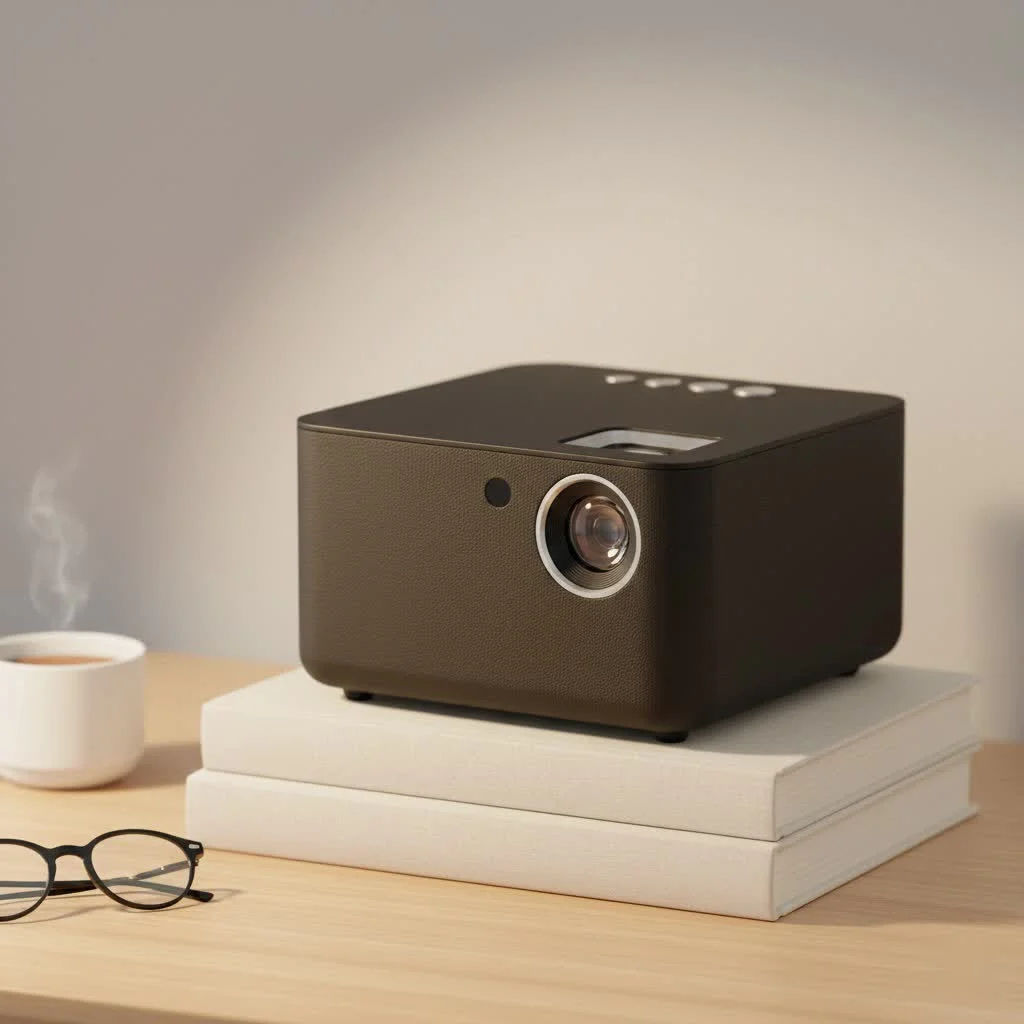
A DLP (Digital Light Processing) mini projector creates an image using a Digital Micromirror Device (DMD) chip, which contains millions of microscopic mirrors that rapidly tilt to reflect light and form pixels. This technology, pioneered by Texas Instruments, is known for producing sharp, responsive images with superior contrast and smooth motion, making it ideal for portable home entertainment and gaming. Most modern DLP mini projectors use energy-efficient LED or laser light sources and are generally smaller and more durable than LCD counterparts.
What is a DLP Mini Projector?
At its core, a DLP (Digital Light Processing) mini projector creates an image using a sophisticated chip called a Digital Micromirror Device, or DMD. This technology, pioneered by Texas Instruments, is the secret sauce behind the sharp, responsive images that DLP projectors are known for. The DMD chip is a marvel of engineering, containing hundreds of thousands, or even millions, of microscopic mirrors. Each tiny mirror corresponds to a single pixel on the final projected image. By tilting toward or away from the light source thousands of times per second, these mirrors craft the bright, dark, and nuanced parts of the picture you see on the screen. It’s this rapid, precise movement that gives DLP projectors their signature smooth and clear quality, a technology so effective it’s used in the vast majority of digital movie theaters worldwide. For shop curated portable mini on this site.
How DLP Technology Powers a Mini Projector
Understanding how a DLP mini projector works is like getting a peek behind the magician’s curtain. The process is a rapid and elegant dance of light and reflection.
- The Light Source: It all begins with a bright light source, which in most modern mini projectors is an energy-efficient LED or laser. This provides the raw light that will eventually become your movie or presentation.
- The Color Wheel: In a single-chip DLP projector (the most common type in mini models), this white light passes through a spinning color wheel. This wheel is segmented into primary colors—typically red, green, and blue. As it spins at high speed, it filters the light, sending sequential flashes of colored light toward the DMD chip.
- The DMD Chip: The colored light hits the array of microscopic mirrors on the DMD chip. Based on the video signal, each mirror rapidly tilts. If a pixel needs to be bright, the mirror reflects light through the lens. If it needs to be dark, it tilts away. By modulating how long each mirror stays in the “on” position for each color, it can create a full spectrum of hues and shades.
- The Lens and Your Eyes: The reflected light travels through the projector’s lens and onto your screen or wall. This entire process happens so fast that your brain doesn’t see separate red, green, and blue images. Instead, your eyes blend them into a single, seamless, full-color moving picture.
“The durability of the DMD chip is a key advantage,” notes Dr. Alistair Finch, a senior optical engineer. “Because the imaging system is based on mirrors sealed within the chip, DLP projectors are less susceptible to issues like dust alignment problems or color decay over time, making them incredibly reliable for portable use.”
The Big Showdown: DLP vs. LCD Mini Projectors
When choosing a mini projector, your main decision will be between DLP and LCD (Liquid Crystal Display) technology. While both can produce a great image, they have fundamental differences that impact performance.
| Feature | DLP Mini Projector | LCD Mini Projector |
|---|---|---|
| Image Contrast | Superior; produces deeper blacks. | Good, but blacks can appear grayish. |
| Motion Handling | Excellent; very smooth for movies and games. | Can sometimes exhibit motion blur. |
| Pixel Structure | Pixels are less visible; no “screen door” effect. | Can have a visible pixel grid (“screen door”). |
| Portability | Generally smaller, lighter, and more compact. | Tend to be bulkier and heavier. |
| Color Brightness | Good, but can be less vibrant than 3LCD. | Excellent color saturation and brightness. |
| Potential Issue | “Rainbow Effect” (brief color flashes). | Requires filter cleaning; potential for dust blobs. |
| Durability | Sealed optics protect against dust. | Not sealed, making it prone to dust. |
Why Choose a DLP Mini Projector?
|
Our Picks for the Best Mini Projector in 2026
As an Amazon Associate I earn from qualifying purchases.
|
||
| Num | Product | Action |
|---|---|---|
| 1 | [Compatible with Netflix & TOF Real-time Focus] Mini Projector with WiFi and Bluetooth, XuanPad Smart Projector 4K Support, Dolby Audio & Keystone, 210° Rotatable Stand for Home |
![Check [Compatible with Netflix & TOF Real-time Focus] Mini Projector with WiFi and Bluetooth, XuanPad Smart Projector 4K Support, Dolby Audio & Keystone, 210° Rotatable Stand for Home on Amazon](https://flasf.com/wp-content/plugins/amazon-tables/assets/images/buy.png)
|
| 2 | SOOMFON Mini Projector 1080P Support - Portable Small Video Movie Projector Bluetooth 5.1 Auto Keystone Electric Focus for Bedroom/Wall/Home/Outdoor/iPhone/Android/TV Stick |
|
| 3 | Aurzen EAZZE D1 Smart Projector with WiFi and Bluetooth, Netflix-Officially-Licensed, Auto Focus & Keystone, DoIby Audio, Native 1080P Movie, Portable Outdoor Mini Projector, White |
|
| 4 | Magcubic Mini Projector with WiFi 6 and Bluetooth 5.4, Portable Projector 4K Support, 5W Soundbase Speaker, Auto Vertical Keystone 180°Rotatable Smart Proyector for Movie Home Outdoor |
|
| 5 | [Short Throw/1200ANSI/Built in Apps] 4K Outdoor Projector with WiFi and Bluetooth, Auto Focus Projector with Dual-Mode Stand, Smart Portable Proyector with Netflix/YouTube/PrimeVideo & Dolby |
|
| 6 | [Built-in Apps & 2025 Upgraded] Mini Projector Support 4K 1080P Auto Keystone 270° Rotatable with WiFi 6 and Bluetooth 5.4, Projector Portable Compatibile with HDMI/TV Stick/Memory Stick/Laptop-Black |
|
| 7 | Mini Portable Projector 4K WiFi 6 BT 5.2 Upgraded Portable Projector Full HD Supported for Phone /PC /TV /HDMI /PS5 /Laptop Auto Keystone Home Theater 180° Rotation [Built-in App] White |
|
| 8 | HAPPRUN Native 1080P Bluetooth Mini Projector, Full HD Portable Outdoor Movie Projector with Built-in Speaker, Compatible with Smartphone, HDMI, USB, AV, Fire Stick, PS5 for Home, Bedroom, Outdoor Use |
|
| 9 | 【Officially-Licensed APP & Native 1080P】Thinnest 1.81\" Smart Mini Projector with WiFi and Bluetooth, Auto Focus & Keystone Portable Outdoor Projector, VOPLLS 4K Support Home Movie Projector |
|
| 10 | Aurzen Roku TV Smart Projector with Wifi and Bluetooth, Roku Streaming Experience Built-in, 1080P FHD, Dolby Audio, Auto Focus & Keystone, Zoom, Movie Portable Outdoor Mini Projector, White |
|
You should lean towards a DLP mini projector if your priorities are cinematic quality, portability, and gaming. The high contrast ratio delivers a rich, film-like image with deep blacks that makes movies more immersive. The fast response time of the mirrors results in incredibly smooth motion, which is a major advantage for watching action movies or playing video games. Their typically smaller size and sealed, low-maintenance design make them the natural choice for on-the-go entertainment.
When an LCD Mini Projector Might Be Better
An LCD mini projector could be a better fit if your primary concerns are color accuracy and use in brighter environments. LCD projectors are known for producing incredibly vibrant and saturated colors. They often have a higher color brightness measurement, which can make them more effective in rooms with some ambient light. If you are a photographer or graphic designer who needs perfect color representation, LCD might have the edge.
Key Features to Look for in a DLP Mini Projector
Navigating the specifications of a DLP mini projector can be daunting. Here are the critical features to focus on to ensure you get a device that meets your needs.
- Native Resolution: Pay close attention to the native resolution. Many projectors will claim to “support” 4K, but their native resolution might be 1080p or even 720p. For a sharp, clear image, look for a native resolution of at least 1080p (1920×1080).
- Brightness (ANSI Lumens): This is one of the most important specs. Brightness is measured in ANSI lumens. For viewing in a dark room, 300-500 ANSI lumens is sufficient. If you plan to use it in rooms with some ambient light, look for 700 ANSI lumens or more.
- Contrast Ratio: This is a traditional strength of DLP technology. A higher contrast ratio means deeper blacks and more “pop” to the image. A ratio of 1000:1 or higher is a good starting point.
- Battery Life: For a truly portable projector, battery life is crucial. Look for models that offer at least 2 to 3 hours of playback on a single charge—enough to get through most movies.
- Connectivity: Ensure the projector has the inputs you need. An HDMI port is essential for connecting laptops, game consoles, and streaming sticks. A USB-C port is a modern, versatile addition. Built-in Wi-Fi and Bluetooth are also huge pluses for wireless streaming and connecting external speakers.
- Keystone Correction and Autofocus: These are quality-of-life features that make setup a breeze. Automatic keystone correction squares the image even if the projector is at an angle, and autofocus ensures the picture is sharp without manual fiddling.
Frequently Asked Questions (FAQ)
What is the “rainbow effect” on a DLP projector?
The rainbow effect is a visual artifact some viewers perceive as brief flashes of red, green, and blue along high-contrast edges. It’s caused by the single-chip system’s spinning color wheel. While modern projectors have much faster wheels that minimize this, a small percentage of people are still sensitive to it.
How long do DLP chips last?
The DMD chip itself is incredibly durable and can last for over 100,000 hours of use, far outlasting the projector’s light source. Because there are no organic components to degrade, the image quality from the chip does not fade over time.
Can I use a DLP mini projector in a bright room?
While you can, the experience is highly dependent on the projector’s brightness (ANSI lumens). A mini projector with low lumens will look washed out in a bright room. For daytime viewing, you need a model with high brightness (over 700 ANSI lumens) and will likely need to control the ambient light by closing blinds.
Do DLP mini projectors require maintenance?
DLP projectors are very low maintenance. Because the critical optical components are sealed, there are no filters to clean or replace, and you don’t have to worry about dust blobs forming on the image. The primary maintenance consideration is the lifespan of the light source, but modern LED and laser sources can last 20,000 hours or more.
Are DLP mini projectors good for gaming?
Yes, they are often excellent for gaming. The fast switching speed of the micromirrors gives them a superior response time compared to LCD projectors, resulting in less motion blur and a smoother experience, especially in fast-paced games. Just be sure to check the projector’s specified input lag.
Conclusion: Your Pocket-Sized Big Screen Awaits
The DLP mini projector stands as a shows how far technology has come, offering a potent blend of portability, performance, and durability. Its ability to deliver sharp, high-contrast images with fluid motion makes it an ideal choice for movie lovers, gamers, and anyone who wants the flexibility of a large screen anywhere they go. While LCD technology has its own strengths, the compact and low-maintenance design inherent to the DLP architecture gives it a distinct advantage in the mini projector space. By focusing on the key features like native resolution, ANSI lumens, and connectivity, you can confidently select a DLP mini projector that will improve your entertainment experience, proving that the biggest things truly do come in the smallest packages.
Frequently Asked Questions
What causes the 'rainbow effect' in DLP projectors?
The 'rainbow effect' is a visual artifact perceived as brief flashes of red, green, and blue, caused by the spinning color wheel in single-chip DLP systems. While modern projectors minimize this with faster wheels, a small percentage of viewers may still be sensitive to it.
How long can a DLP chip typically last?
A DLP's DMD chip is exceptionally durable, designed to last over 100,000 hours of use, significantly outliving the projector's light source. Since it contains no organic components, the image quality from the chip does not degrade over time.
Can a DLP mini projector be used effectively in a bright room?
Using a DLP mini projector in a bright room depends heavily on its brightness, measured in ANSI lumens. For acceptable daytime viewing, a model with over 700 ANSI lumens is recommended, and controlling ambient light by closing blinds will further improve the experience.
What kind of maintenance do DLP mini projectors require?
DLP mini projectors are very low maintenance because their critical optical components are sealed, preventing dust accumulation. This means there are no filters to clean or replace, and dust blobs on the image are not a concern. The main maintenance is monitoring the light source's lifespan, which for modern LED and laser sources can exceed 20,000 hours.
Are DLP mini projectors a good choice for video gaming?
Yes, DLP mini projectors are often excellent for gaming due to the fast switching speed of their micromirrors. This results in superior response times compared to LCD projectors, leading to less motion blur and a smoother experience, particularly in fast-paced games. Users should check the projector's specified input lag for optimal gaming performance.
Get our weekly buyer guide
Practical specs, not advice. Unsubscribe anytime.
I picked up a mini projector with an LED light source, hoping for great battery life on camping trips. While the picture is decent and it’s super compact, I found the brightness to be a bit low for anything but a completely dark tent. It’s fine for casual viewing, but don’t expect a cinema-like experience outdoors unless it’s pitch black. Good for what it is, but has limitations.
Got one of these after reading about the superior contrast and smooth motion. It really delivers on that front, especially for sports. My only minor complaint is that the built-in speaker isn’t super loud, so I usually have to connect it to an external Bluetooth speaker for a better audio experience. Still, for the size and picture, it’s a solid buy.
I’ve been looking for a good portable projector for ages, and the explanation of the DMD chip really sold me on DLP. The image quality is fantastic, super sharp even when projected onto a slightly textured wall. It’s perfect for movie nights in the backyard, and the kids love it for gaming too. Definitely a game-changer for our family entertainment!
I was hesitant about getting a mini projector, but the durability aspect mentioned for DLP models convinced me. I’ve taken mine on a few trips already, and it holds up great. The setup is incredibly easy, and the picture quality for streaming shows on the go is surprisingly good. It’s become an essential part of my travel kit.