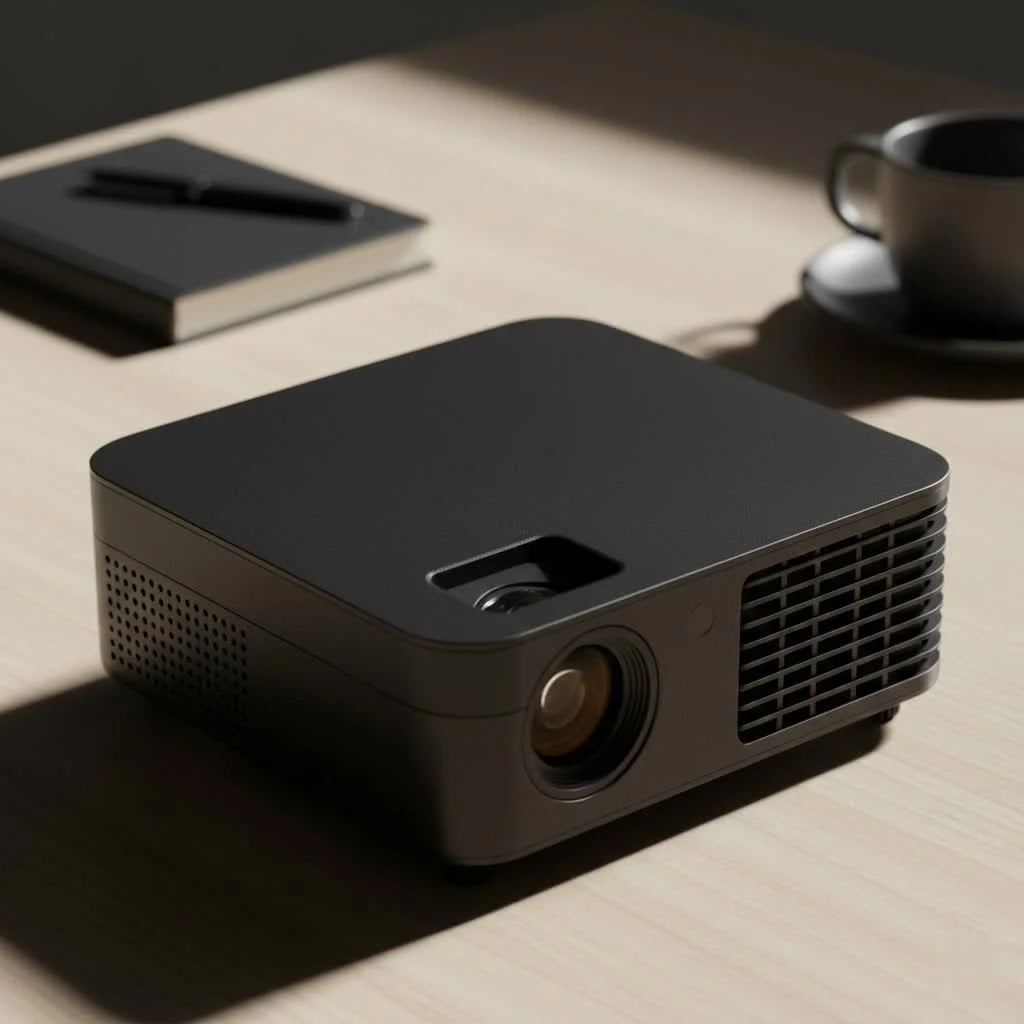
A mini LED projector is a compact, portable device that uses Light Emitting Diodes (LEDs) as its light source to project an image onto a screen or surface. These projectors are designed for convenience, offering a blend of performance and portability that has revolutionized on-the-go entertainment and business, making them ideal for movie nights, gaming, and presentations without heavy equipment.
How Does Mini LED Projector Technology Work?
To truly appreciate what a mini LED projector can do, it helps to understand the magic happening inside. The core of the technology is the LED light source, which is a major upgrade from the old-school projector lamps. For compare top portable mini on this site.
Traditional projectors use a single, high-intensity lamp that generates a lot of heat and has a relatively short lifespan. In contrast, a mini LED projector uses separate red, green, and blue LEDs. The device can create any color in the spectrum by precisely combining the light from these three sources. This process is not only more efficient but also produces more vibrant and accurate colors.
This solid-state technology means there are fewer moving parts, no fragile filaments to break, and no lengthy warm-up or cool-down times. You just turn it on, and you’re ready to go.
The Key Advantages of Choosing an LED Projector
Why are so many people making the switch to a mini LED projector? The benefits are compelling, especially for modern lifestyles that value flexibility and efficiency.
Unmatched Portability and Convenience
This is the most obvious benefit. Mini projectors are designed to be small and lightweight. Many can fit in the palm of your hand, easily slipping into a bag or even a large pocket. This opens up a world of possibilities:
- Outdoor Movie Nights: Set up a cinema in your backyard in minutes.
- Impromptu Gaming Sessions: Connect your console and play on a massive screen at a friend’s house.
- On-the-Go Business Presentations: Walk into a meeting room and project your slides without needing the venue’s equipment.
Incredible Lifespan and Durability
One of the biggest hidden costs of traditional projectors is lamp replacement. A typical projector lamp might last between 2,000 to 5,000 hours, and a replacement can be expensive.
LEDs, on the other hand, are built to last. The light source in a mini LED projector is often rated for 20,000 to 30,000 hours. To put that in perspective, if you watched a two-hour movie every single day, the LED would last for over 27 years. This incredible longevity means you’ll likely replace the projector itself before you ever have to worry about the light source dying.
Superior Energy Efficiency
|
Our Picks for the Best Mini Projector in 2026
As an Amazon Associate I earn from qualifying purchases.
|
||
| Num | Product | Action |
|---|---|---|
| 1 | SOOMFON Mini Projector 1080P Support - Portable Small Video Movie Projector Bluetooth 5.1 Auto Keystone Electric Focus for Bedroom/Wall/Home/Outdoor/iPhone/Android/TV Stick |

|
| 2 | Aurzen EAZZE D1 Smart Projector with WiFi and Bluetooth, Netflix-Officially-Licensed, Auto Focus & Keystone, DoIby Audio, Native 1080P Movie, Portable Outdoor Mini Projector, White |
|
| 3 | Aurzen Roku TV Smart Projector with Wifi and Bluetooth, Roku Streaming Experience Built-in, 1080P FHD, Dolby Audio, Auto Focus & Keystone, Zoom, Movie Portable Outdoor Mini Projector, White |
|
| 4 | Magcubic Mini Projector with WiFi 6 and Bluetooth 5.4, Portable Projector 4K Support, 5W Soundbase Speaker, Auto Vertical Keystone 180°Rotatable Smart Proyector for Movie Home Outdoor |
|
| 5 | [Short Throw/1200ANSI/Built in Apps] 4K Outdoor Projector with WiFi and Bluetooth, Auto Focus Projector with Dual-Mode Stand, Smart Portable Proyector with Netflix/YouTube/PrimeVideo & Dolby |
|
| 6 | 【Officially-Licensed APP & Native 1080P】Thinnest 1.81\" Smart Mini Projector with WiFi and Bluetooth, Auto Focus & Keystone Portable Outdoor Projector, VOPLLS 4K Support Home Movie Projector |
|
| 7 | Mini Portable Projector 4K WiFi 6 BT 5.2 Upgraded Portable Projector Full HD Supported for Phone /PC /TV /HDMI /PS5 /Laptop Auto Keystone Home Theater 180° Rotation [Built-in App] White |
|
| 8 | [Compatible with Netflix & TOF Real-time Focus] Mini Projector with WiFi and Bluetooth, XuanPad Smart Projector 4K Support, Dolby Audio & Keystone, 210° Rotatable Stand for Home |
|
| 9 | HAPPRUN Native 1080P Bluetooth Mini Projector, Full HD Portable Outdoor Movie Projector with Built-in Speaker, Compatible with Smartphone, HDMI, USB, AV, Fire Stick, PS5 for Home, Bedroom, Outdoor Use |
|
| 10 | [Built-in Apps & 2025 Upgraded] Mini Projector Support 4K 1080P Auto Keystone 270° Rotatable with WiFi 6 and Bluetooth 5.4, Projector Portable Compatibile with HDMI/TV Stick/Memory Stick/Laptop-Black |
|
LEDs consume significantly less power than traditional projector lamps. This not only helps reduce your electricity bill but also makes them perfect for battery-powered operation. Many mini projectors come with a built-in rechargeable battery, giving you true wireless freedom for a few hours of projection without needing to be near a power outlet.
What to Look For When Buying a Mini LED Projector
Navigating the market can be tricky, with a lot of technical jargon thrown around. As an expert, I want to demystify the most important specifications so you can make an informed decision.
Brightness (ANSI Lumens)
Brightness is arguably the most critical factor. It’s measured in ANSI lumens, and this is the number you should pay attention to. Some manufacturers advertise “LED lumens” or “peak brightness,” which are often inflated marketing terms.
- 100-300 ANSI Lumens: Suitable for very dark rooms. Ideal for casual movie nights where you can control the ambient light completely.
- 300-800 ANSI Lumens: A great middle ground. This level is bright enough for rooms with some ambient light, making it more versatile for presentations or watching with the lights dimmed but not off.
- 800+ ANSI Lumens: Considered very bright for a mini projector. These models can perform reasonably well even in rooms that aren’t completely dark.
Native Resolution
Resolution determines the clarity and sharpness of the image. You’ll see two specs: “supported resolution” and “native resolution.” Always focus on the native resolution, as this is the true resolution of the projector’s display chip.
- 480p (854×480): Entry-level. Fine for casual viewing or cartoon-style content, but text and fine details will appear soft.
- 720p (1280×720): HD resolution. This is the sweet spot for many, offering a good balance of clarity and cost for movies and gaming.
- 1080p (1920×1080): Full HD. This provides a sharp, crisp image that’s excellent for detailed presentations and a cinematic movie experience.
Connectivity Options
A projector is useless if you can’t connect your devices to it. Look for a variety of inputs to ensure maximum compatibility.
- HDMI: The most important port. It’s the universal standard for connecting laptops, game consoles, and streaming sticks.
- USB: Allows you to play media files directly from a flash drive or external hard drive. Some also offer power output to charge your phone.
- Wi-Fi and Bluetooth: Essential for modern convenience. Wi-Fi enables wireless screen mirroring from your phone or laptop, while Bluetooth lets you connect to external speakers or headphones for better audio.
Keystone Correction and Autofocus
Setting up a projector perfectly can be a hassle. These features make it much easier.
- Keystone Correction: This feature allows you to square up the image if the projector isn’t placed perfectly perpendicular to the screen. Auto keystone correction is a huge plus, as it does this for you automatically.
- Autofocus: A premium feature that automatically adjusts the focus for a sharp image, saving you from fiddling with a focus wheel.
Potential Downsides to Consider
While the mini LED projector is a fantastic piece of tech, it’s important to have realistic expectations. They are masters of portability, but this comes with some trade-offs compared to full-sized home theater projectors.
- Limited Brightness: Even the brightest mini projectors can struggle in a well-lit room. For the best experience, you will always need a dim or dark environment.
- Onboard Audio Quality: The built-in speakers are usually weak. While convenient in a pinch, you will almost certainly want to connect an external Bluetooth speaker or soundbar for an immersive audio experience.
- Battery Life: If the model has a battery, it typically lasts for 2-3 hours. This is enough for a movie, but not for a binge-watching session without plugging it in.
Frequently Asked Questions (FAQ)
What is the difference between a mini LED projector and a pico projector?
The terms are often used interchangeably. Generally, “pico projector” refers to the absolute smallest, pocket-sized models, while “mini projector” is a broader category that includes pico projectors and slightly larger, but still portable, units that often have better brightness and features.
Can I use a mini LED projector for outdoor movies?
Absolutely! This is one of their most popular uses. Just that you’ll need to wait until it’s fully dark outside for the image to be bright and vibrant. You’ll also need a portable power source if your movie night will last longer than the built-in battery.
Do I need a special screen for a mini projector?
While you can project onto a plain white wall, a dedicated projector screen will always provide a better image. Screens are designed to reflect light more uniformly, which enhances contrast and color saturation. However, for casual use, a smooth, light-colored wall is perfectly acceptable.
Can I connect my smartphone to a mini projector?
Yes. Most modern mini projectors support wireless screen mirroring via Wi-Fi (using technologies like Miracast or AirPlay). For a more stable connection, you can also use a wired adapter that connects your phone’s charging port to the projector’s HDMI port.
Is a mini LED projector good for business presentations?
It can be an excellent tool for mobile professionals. A model with at least 500 ANSI lumens and a 720p or 1080p native resolution is ideal for ensuring text and charts are clear and readable in a typical meeting room with controlled lighting.
The Final Takeaway
A mini LED projector is a versatile, powerful, and fun device that brings big-screen entertainment and presentations anywhere you go. By focusing on the key specifications—ANSI lumens, native resolution, and connectivity—you can cut through the marketing noise and find a model that perfectly suits your needs. Whether you’re a movie buff, a gamer, or a professional on the move, the convenience and long-term value offered by LED technology are undeniable. Now go on, take your viewing experience to the next level
Get our weekly buyer guide
Practical specs, not advice. Unsubscribe anytime.
Absolutely love my new mini LED projector! I was hesitant about the performance compared to larger models, but the image quality for home entertainment is fantastic. We’ve used it for movie nights in the living room and even projected cartoons onto the ceiling for my niece. The fact that it uses LEDs means I don’t have to worry about replacing expensive lamps, which is a huge plus.
I’ve been wanting a portable projector for ages, and this guide really helped me pick one out. The explanation of how the separate red, green, and blue LEDs work to create colors was super helpful. I got one for outdoor movie nights with the kids, and the picture quality is surprisingly good even on a bedsheet. It’s so easy to set up and move around.
This mini LED projector has been a game-changer for my business trips. I used to lug around a heavy old projector for presentations, but this compact device fits right in my carry-on. The brightness is decent for a small meeting room, though in a really bright room, it can be a bit washed out. Still, the convenience factor makes it totally worth it.
I picked up a mini LED projector primarily for gaming on the go, and while it’s cool for casual stuff, I noticed a bit of input lag with faster-paced games. It’s great for watching YouTube or a movie, but if you’re a serious gamer, you might want to manage expectations. The portability is fantastic though, and it’s definitely an upgrade from traditional lamp projectors in terms of lifespan.